EMR
Endoscopic Mucosal Resection (EMR) in Rewa
What Is Endoscopic Mucosal Resection (EMR)?
EMR is performed through an endoscope or colonoscope, without an external surgical incision. Whether it is suitable depends on the growth’s size, location, appearance and depth.
Â
Why Might EMR Be Recommended?
Your gastroenterologist may recommend EMR when an abnormal area needs to be removed for treatment and detailed laboratory examination.
It may be considered for:
- Selected large or flat polyps in the colon.
- Certain superficial abnormal growths in the food pipe, stomach or duodenum.
- Precancerous changes in the digestive tract lining.
- Selected early cancers following specialist assessment
EMR is not suitable for every growth. Lesions extending into deeper layers may require another endoscopic technique or surgery.
How Is EMR Performed?
The procedure is usually performed with sedation or anaesthesia, depending on the treatment site and clinical requirements.
For the upper digestive tract, an endoscope is passed through the mouth. For the colon, a colonoscope is passed through the anus.
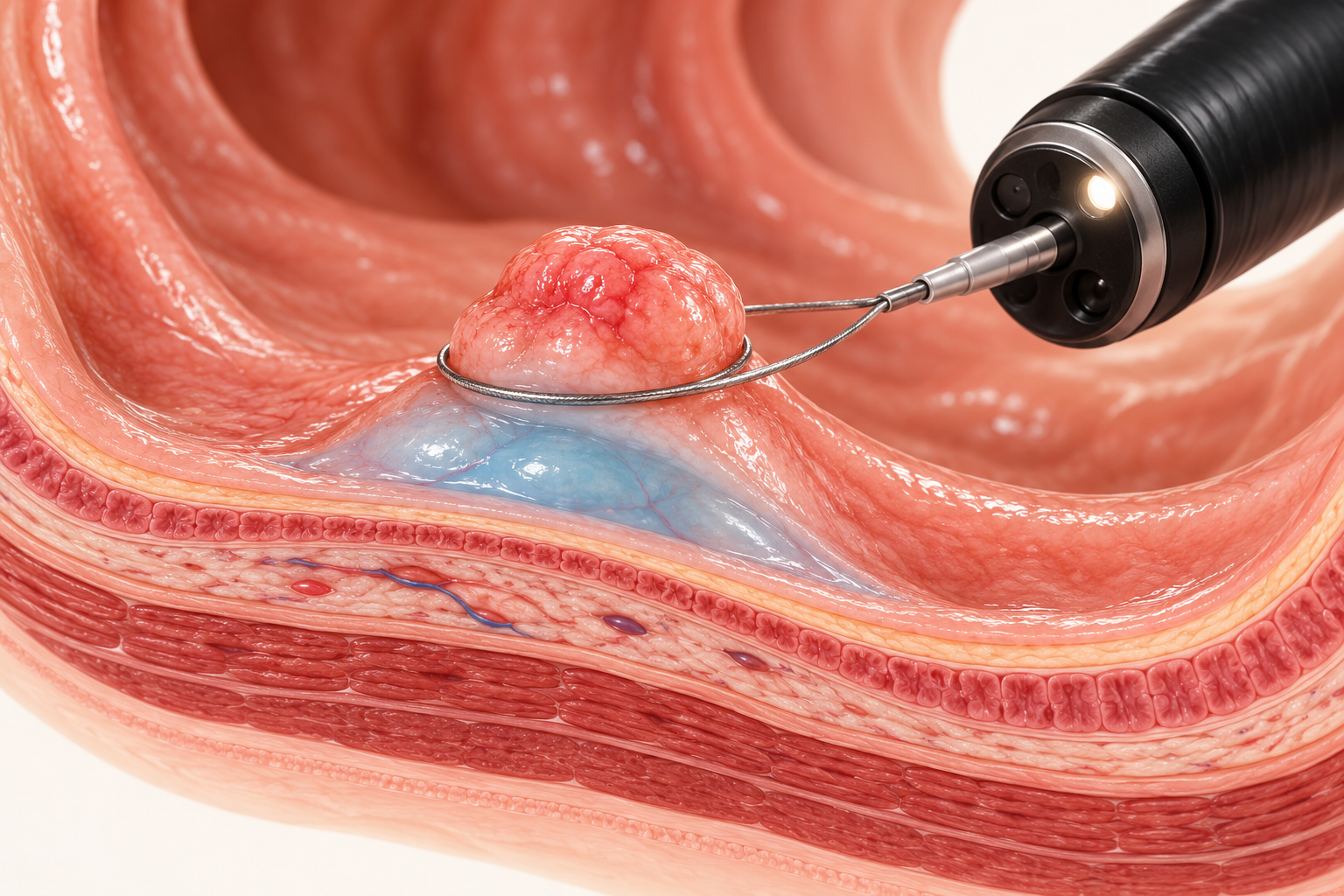
In many cases, fluid is injected beneath the abnormal tissue to lift it away from deeper layers. A thin wire loop, called a snare, is then used to remove the tissue. Depending on its size, the growth may be removed in one piece or several pieces.
The removed tissue is sent for laboratory examination. Clips or other endoscopic treatments may be used where needed to control bleeding or close the treatment area.
How Should I Prepare?
Preparation depends on the part of the digestive tract being treated.
- Follow the fasting and dietary instructions provided by your treating team.
- If EMR is planned in the colon, complete the prescribed bowel preparation.
- Share previous endoscopy reports, biopsy results and relevant investigations.
- Tell the team about all medicines, supplements, allergies and existing medical conditions.
- Ask for specific instructions about blood thinners, diabetes medicines and weight-loss injections.
- Arrange for a responsible adult to take you home if sedation is planned.
Do not stop or change prescribed medicines unless your treating doctor advises you to do so.
What Happens After the Procedure?
You will be monitored after treatment. Depending on the extent of the procedure and your recovery, you may go home the same day or need a hospital stay.
Your team will provide instructions about eating, drinking, medicines and physical activity. Follow any restrictions related to sedation.
The laboratory results help determine whether the abnormal tissue has been adequately treated or whether further treatment is needed. A follow-up endoscopy may be recommended to check healing and look for remaining or recurrent tissue.
What Are the Possible Risks?
The risks depend on the treatment site, the size of the growth and your overall health. They may include:
- Bleeding during the procedure or afterwards.
- A tear or hole in the digestive tract wall, called a perforation.
- Pain or inflammation at the treatment site.
- Reactions or breathing problems related to sedation or anaesthesia.
- Scarring and narrowing, particularly after extensive treatment in the food pipe.
- Incomplete removal or recurrence, requiring further treatment.
Delayed bleeding can occur after you have gone home, including up to two weeks after some bowel EMR procedures.
Seek urgent medical attention if you develop severe or worsening chest or abdominal pain, fever, breathing difficulty, vomiting blood, black stools, significant rectal bleeding, dizziness or fainting.
Dr. Lavkush Prasad Tiwari
MBBS, MD (INTERNAL MEDICINE), DM (MEDICAL GASTROENTEROLOGY)
SMR: MP12467
Click HereHow can we help you?
Contact us at the Gastro World & Liver Centre Rewa (MP) Or make an appointment online.